Solitude canyon
My realistic view of the landscape seems to be reshaping itself with this place. The chimera lies in the outline of appearances, mythological and timeless. I found a enigma that gave me a name—"Solitude Canyon.
Part 1 - Revelation
One autumn morning, during a walk through the Cabril Valley, a pleasant place near my home, two extraordinary things happened that left a lasting impression and, in the months that followed, inspired me to create a new series of paintings. The intriguing and truly exceptional event was meeting Daniel on the same day I discovered the "Linden Canyon," one of those mythical places you don't encounter often. Two distinct events occurred that day; if they had happened on different days, they wouldn't have had the impact they did, but taken together, the experience was remarkable. The fact was that these events were anything but ordinary; first, the way I discovered the "Linden Canyon," which seems almost fictional, and then, the fact that I met Daniel in the exact same place where, three years earlier, Joana had built one of her stone pyramids, seemed to me much more than a coincidence. When I first met Daniel, he seemed like the kind of person who lives in communion with nature, an ascetic seeking knowledge, a hermit. But that first impression was misleading. I was led to believe this because the context was pulling me in that direction, influenced by the events of that day. After all, he was an ordinary person, with some exceptional characteristics, yes, but not that kind of character. Daniel is someone who, like me, lives near Lisbon and comes here regularly for a few days at a time, and who also frequents the Cabril Valley. What he does while there and what he builds from what he finds in this land is what makes him exceptional. What I felt at the "Tílias Canyon." The first impression I had of seeing Daniel, barefoot, with his feet in the stream right next to the pyramid my friend Joana had built, were the events that had an extraordinary influence on me that day and gave me a great impetus to start the paintings in the "Solitude Canyon" series.
A few days earlier I had just returned from Estoril, after completing a difficult architectural project because the client was particularly indecisive and demanding, a fatal combination that resulted in constant back and forth. In an already complicated process, things were getting worse and worse. I had spent weeks in countless, endless meetings to discuss ideas that were constantly changing.
When I arrived at Mação's house, I felt relieved to have finished my ordeal, yet, at the same time I felt the need to take a few walks along the mountain trails to clear my head and leave behind the confusion of the previous days. I knew it would be some time before I entered "painting mode."
I open the wooden shutters and say good morning to Monte do Castelo Velho, which rises before me, clear and glorious with its green canopy. The dream left a bad impression, a glimpse of world news, in its nocturnal and claustrophobic version, but light filters such things, reality dispels the shadows. The window is open, with the immense blue in the background. The radiant morning atmosphere enters the house. The filigree of the mountain's sound fills the room, minimalist frequencies bringing with them the grandeur of the place. Good morning to Castelo Velho. Good morning to the forest. I take a deep breath, and the air smells of wet earth. If the shadows of my restless night had survived the dawn, they would have been erased by such an intense and penetrating aroma. The only visible shadow is in the sky high above me, a griffin flying with its graceful movements, soaring over hills and valleys with its telescopic vision, noticing every movement, noticing me, peering through the window of my lonely house.
The voice that whispered to me during my dream is right; there's no reason to drag the urban chaos into the griffon's territory. It flies at altitudes where the rising currents are, it dominates the high ground. Down here, the morning begins normally, where the plants thrive naturally, needing no gardener, where the woods outside my house thrive and have their own orchestra of chirps in perfect harmony. The urban noise doesn't disappear by miracle, just because I wish it would. When I return to Estoril, it will be there again, the chaos, but here it's attenuated, almost forgotten, and the faster the process of forgetting it, the better.
During breakfast, I turn on the TV, and the news comes on, reported by the professional voice. It's deja vu. The discomfort that newscasts have become. I put it on my mental agenda—I don't need this.
I go outside with my breakfast cup; the day is fine. In the courtyard, everything is the same, except for the little things; Plants that have grown since I was last here, the stone wall covered in green moss, one of the three rose bushes has thrived, the other two are dead, lemons growing on the lemon tree I planted last spring, a family of sparrows has nested on the shed, a new addition to the cat family. The little things, the details that make this place real, the elements that populate my experience in the archaic geography.
The pendulum of my travels between Estoril and Mação leads me to compare "here" and "there" in an exercise for me to get used to this niche of the planet, where what's most noticeable is the silence. Perhaps last night's dream left me predisposed to justify my aversion to the tangled tale of civilization, to the noisy city that neither sleeps nor rests.
Getting from one side to the other is a two-hour drive, the necessary asphalt circuit before reaching the green border, the transition between fullness and emptiness. In Estoril, I organize my things for the days I'll be away. The usual kit of bags, new canvases, new paints, but also the PC and camera. With the anticipation of what is to come, I feel the touch of paradise, a preview of the "click" that happens when crossing the portal that divides one place from the other. At an arbitrary point on this journey, there is a passage of imperceptible density that changes everything, changes the geography and also my predisposition to see things, because when I reach my destination, the world has changed, something has remained on the other side, on this side other things materialize with a different frequency. The change happens in a second, like an infinitesimal change in the density of the air, a subtle flapping of wings in the enclosed space of the car, inside the armor that for a second becomes a ship cruising toward a point lost on the map.
The change that occurs during the journey has a featherweight that settles wonderfully on the ground "here," which is dusty and irreverent, not manufactured by anyone, a realm as vast as one might like, buffeted by persistent gusts of north wind, which raises a dust in the air that irritates the eyes and leaves a harsh taste in the throat, then settles and becomes a sleepy bed to delude us into the idea that nothing special is happening.
Some of those who live "there," within the city's geography, have an artificial posture and obey the martial law of competition for space. Not all are disrespectful, but some defend their citadels tooth and nail. Each with their own artifacts, they want to dominate, they think they own the world, they trample each other mercilessly, they despair of maintaining their status, they are anxious, they take sleeping pills, they drink heavily, and euphorically tell each other random stories. They stage their adventures in a theater of many languages, made of grand gestures, about important things, of sayings and unsaid, voices in tune with one another, full of hope, with the irreverence of being more and being greater than anything. People with long strides who have forgotten much, but who do not forget how ambitious they are. When I'm there, I'm like them, a deluded man defending lost causes, a wasted land pirate, harboring unresolved grievances. By saying these things, I'm generalizing and pointing out what bothers me most, but because there are people who don't hurt anyone and just care about their own lives, everyday life in the city is going on. It turns out that, as time goes by, I become less tolerant, I resent snobbery and trivialities, so I tend to see things as worse than they really are.
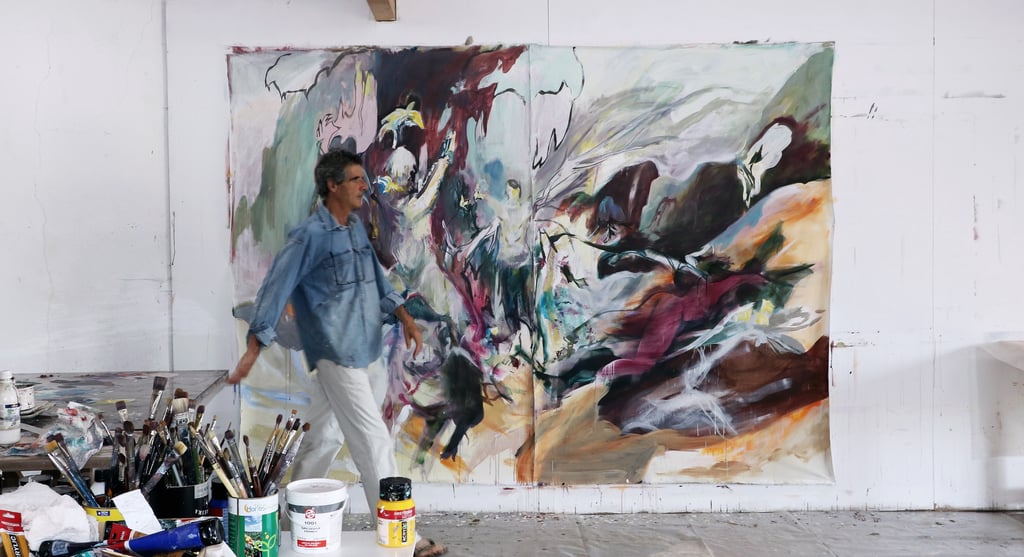
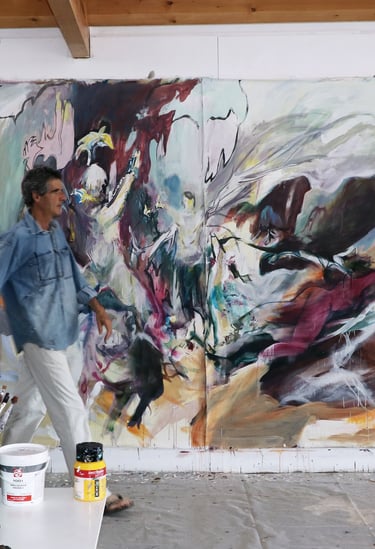
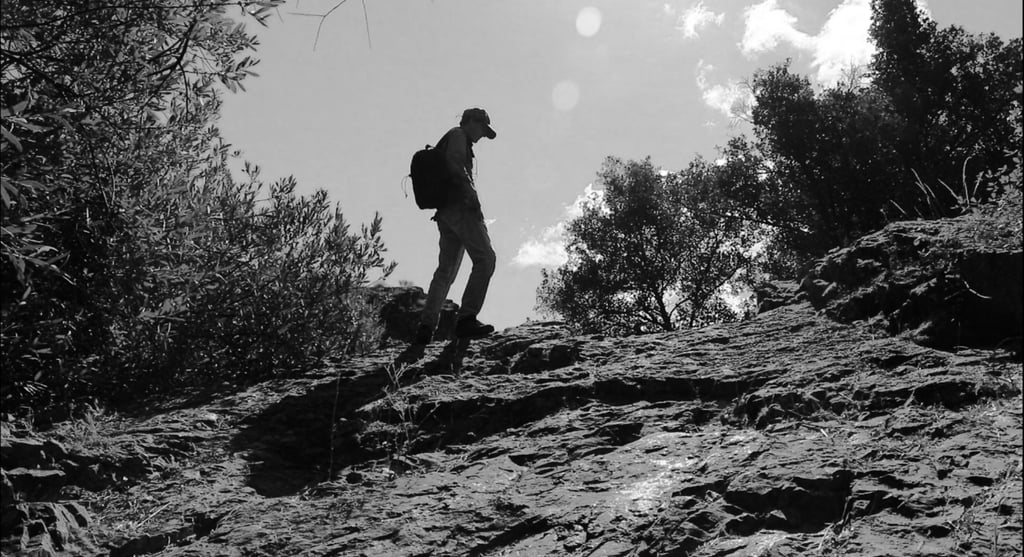
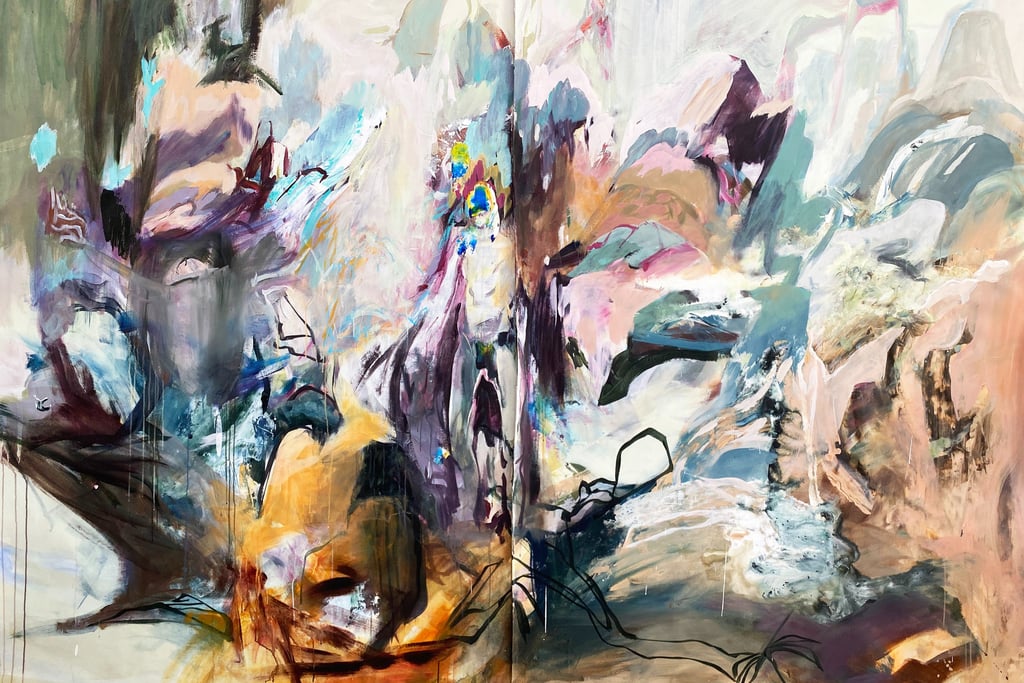
On the studio wall remains the sheet of paper with the title "Solitude Canyon." It's there to remind me of the focus of the work. The words relate to a place I recently discovered. Without this discovery, this year's paintings wouldn't exist. I found the first clue to get there in an old photo. While sorting through some drawers in my office, I came across a stack of old photos tucked inside a yellowed envelope with a date, “1985”. They were black-and-white prints I'd developed in my studio back to my bachelor days. The photographs were from a short vacation I spent in this same house at the end of the summer of that year, certainly at a time when my parents were away and the house was free for my get-togethers.
Back then, people were more careful when taking photos, because the reproduction process was slow and complex, not instantaneous and disposable like today. So, photos were elaborate; the framing was chosen, and the shot was "the moment" when something special happened in front of us. Perhaps that's why these old photos seem to me to have a certain theatricality, an elaborate aesthetic, and a revealing expression of the characters in them, committed to discovering pleasant corners of nature. Discovering nature, that's what we were doing when most of the photos were taken. You can see there were multiple cameras, multiple photographers, and multiple styles. The best ones were taken by Zé, the group's on-call photographer; he was the one who took the best photos in the collection. The adventure lasted an entire day. The group hikes mountain trails, visits paradisiacal places, socializes, and records the various places they visited with an aura of lightness and carefreeness. Some places are recognizable, others less so. In some photos, the group poses, having fun in front of the camera. The spirit of their youth lingers in these images. One of the photos caught my attention, for its unusual framing and because of me posing, pictured nearby the Ribeira do Cabril, a place that always makes my bells ring. The photo is taken from above, probably from the cliff that borders the canyon. Below, the stream winds between boulders, and the water, which has always been clear there, appears as a black and opaque liquid. Dressed in white, I'm in a contemplative pose, with one foot on a large rock, arms crossed, looking straight ahead. On the canyon walls are hanging plants that have sunk roots into the rock, growing obliquely and with an unusual geometry, which I imagine must have captivated my attention. In this image, the sky isn't visible, but it's clear that there are no shadows. What stands out most in the photo is the texture of the cliffs, which are composed of layers of rocks in varying shades of gray, with a gradient from dark to light, from bottom to top, giving the impression of the valley's depth. The overall darkness of the photo contrasts with the white clothing I'm wearing.
Looking closely at the photograph, I noticed a gap in the rock, a vertical shadow that indicated a cut in the stone. In another photo of the same spot where I'm not, this is even more visible.
Empirically, I suspected I knew the place; even after a few years, it wouldn't be impossible to find that section of the stream. It would be interesting to compare the before and after and see how nature evolved there. I was curious to learn more about that dark gap in the valley's cliff, because I had no memory of it.
A few weeks later, I organized a solo expedition to the Cabril Valley, and after walking up and down the section of the stream where I suspected the frame was, I finally found the spot where the photo had been taken.
To my surprise, when I stood at the spot where I'm supposed to be in the picture, I found that the gap was not visible, because the bushes that had grown in the meantime obscured that part of the cliff, and I had to look more closely until I found an angle where the break in the cliff could be seen. After groping through the bush for a while, I discovered a path right between two limestone walls, so narrow that sunlight barely enters. The ground there was soggy because a trickle of water ran along the path. Above, the space between the two walls was small, and lines of viscous moisture flowed across the surface of the stone. The place was claustrophobic; only a sliver of sky was visible, and even that strip of light was obscured by the branches that had taken root on the top. As I advanced, the passage narrowed even further, to the point of squeezing and forcing me to walk sideways. Just when it seemed like it was going nowhere and I was about to turn back, a great surprise happened. I was struck by a burst of light, and that incredible space opened up, a circular clearing with lime trees all around, a small Eden hidden beyond the valley's cliffs, closed on all sides by the rocky ravines except for the narrow opening through which I entered.
In the center, a trickle of water runs, and lush green grass covers the ground. The light reflects off the limestone walls, which are very light, almost white. Perhaps that's why there's a luminosity that seems to absorb the physical complexion of the elements. The linden leaves sparkle in the backlight of the light-colored rock, seemingly illuminated from within. The stream's water is a liquid diamond. There's a sharp visual perfection, a harmony that I feel on my skin and in my senses like the smoothness that nature applies to its creations. Once you are there, one feels a resistance, a necessary adaptation for the senses to attune to the site's singular dimension. For the first few seconds, everything seems still and silent, but this sensation of temporal stasis dissipates, and the environment reveals its many layers. The cricket begins to sing again, the water murmurs in the stream, the wind whispers and makes the grass ripple, the leaves resume their movement, and the birds lose their fear and begin to chirp again. On the ground, the sun defines a line in the middle of the clearing, with light on one side and shadow on the other. But the orientation of the space is such that, at certain times of the year, the sun can quite easily shine on almost every spot. This is "my place"—a paradise where very few must have set foot. Hardly anyone gets here, much less finds the tricky passage to get in.
My realistic view of the landscape seems to be reshaping itself with this place. The chimera lies in the outline of appearances, mythological and timeless. I found an enigma that gave me a name—"Solitude Canyon."
Without knowing how, in the days following my discovery, I wanted to give substance to the idea by making some attempts on the white canvases, a work that always fell short of what I wanted, but now things have changed, I feel that the concept has matured, there is a model in my memory, I have a clear notion of it with its outline of what is raw and ageless. I just close my eyes and I automatically feel transported there, and from then on, things work out. I revive the moments of lying on the ground surrounded by grass, face up watching the movement of the clouds in the sky. Lulled by the illusion that I'm in a stone canoe gliding through a green sea. Even as I imagine the situation, I notice new things that pop up in my mind, as if they materialize according to the mood of the day.
At the beginning of each work session, I thank the gods for discovering such a place where my senses are attuned and reverberated. It's an experience with the complexion of sacred things, of the situations that mark a person's life. The feeling I get after spending some time there is of a high-definition reality where every little thing has dramatic acuity.
I asked Joaquim if he knew the place. "I don't go there often," he replied. From his expression, he must have thought I was fantasizing in my descriptions, about the superb light I found there, so strange it seemed unreal, and also about the perfect acoustic quality. I see skepticism in his face that such a place exists. Joaquim is pragmatic, and it's natural that my words created some resistance in his mind. His laconic smile suggests he's developing an interpretation of my words. Still, according to the canons of the local man, he knows there are places around here where a man can lean against the shade of a tree and admire nature.