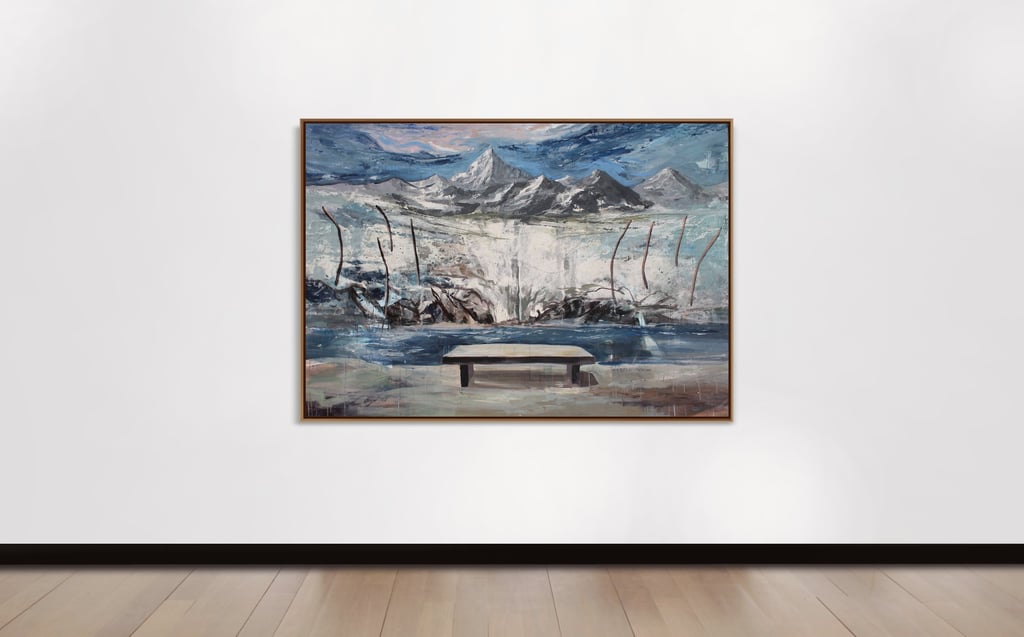
Explaining a painting can sometimes spoil the pleasure of seeing it — of looking freely, without constraints, and simply feeling the emotions it evokes. Still, on the day I opened the Vivificatur exhibition, something happened that made me reflect on one of the works on display — something I rarely do.
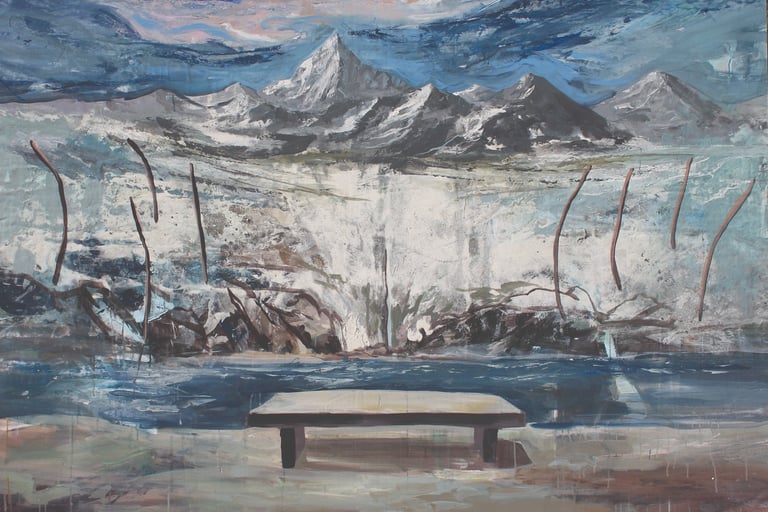
That day, a man approached me and asked about the meaning of the painting Eagle Vision. I didn’t know what to say. I could easily have replied that I had no explanation for it. As we stood there together in front of the canvas, I suddenly became aware of how stark and cold it appeared. For the first time, I tried to find a reason for what I had painted. Sensing my hesitation, the young man pressed further.
— “Those brown lines — what do they mean?”
His question made it even harder to answer. By isolating a single element, he had stripped it from its whole. As I stared at the painting, waiting for some insight to surface, my eyes wandered across the gallery to another work — the installation Losing the Big Picture. In that instant, the two pieces seemed connected by an invisible thread; they had been created around the same time, and the meaning of one seemed to depend on the other. It felt like a good place to start.
“You know,” I began, “it’s sometimes hard to understand the meaning of a painting outside the context of a series. This picture represents a landscape, but what truly matters isn’t its formal composition. Everything in it has a symbolic value.”
He looked puzzled, slightly uneasy, so I decided to simplify.
“This painting is about absence.”
The moment I said the word, his face lit up.
— “I understand now — the meaning of an empty bench in the middle of a devastated landscape.”
— “But whose absence is it?” he asked.
At that point, I felt it best to close the subject.
“It’s not a personal absence,” I said. “It’s a broader idea — absence in the general sense. There’s no particular person or thing involved.”
I smiled, apologized, and moved toward a nearby group, hoping I wouldn’t have to explain every painting in the room.
A few days later, I thought about that conversation and felt a little guilty for not having tried harder to explain what was in the painting — or what had inspired it. I wished I’d made more of an effort, but at an exhibition opening, it’s hard to have the presence of mind to articulate something you’ve never consciously considered before. Now that some time has passed, I’ve been able to form a few ideas about what the painting might represent. And even though it’s unlikely that man will ever read these words, I feel I owe him this explanation.
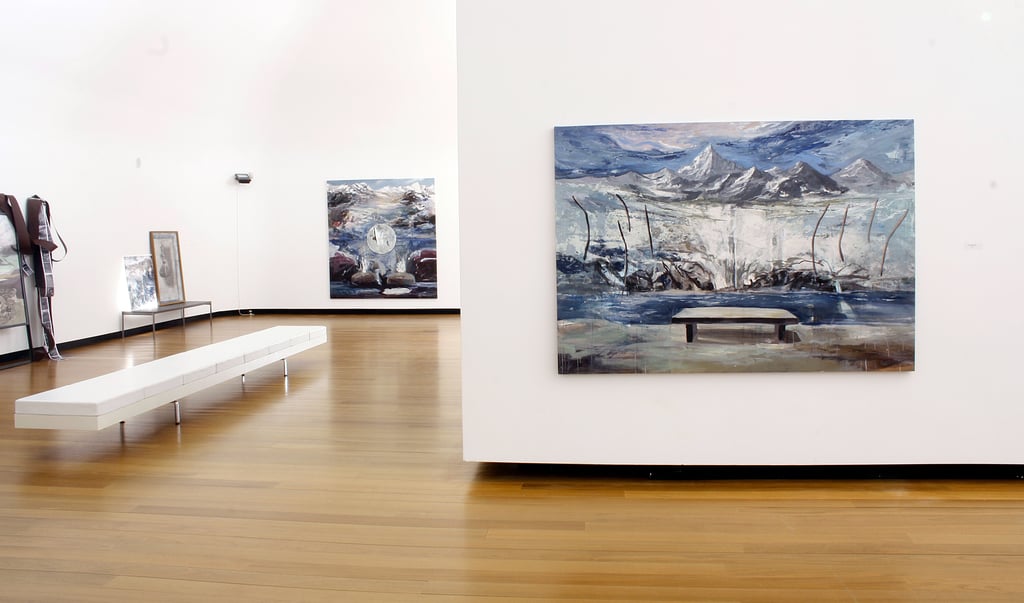
One of the most fascinating aspects of painting is its ability to be seen in countless ways. I’ve come to realize this over the years, every time I show my work. I always hear a wide range of interpretations — each one revealing what others believe they see. Even in my studio, when friends drop by, our conversations often circle around the paintings. Sometimes an outsider’s reading is completely opposite to my own, and that difference always makes me think. No matter how concrete or seemingly objective an image is, it’s almost impossible to reach a true consensus on what it represents. Even when opinions stay close to the main idea, they inevitably diverge at some point. The more subjective the work, the softer its contours, the broader its meaning — and the richer the interpretations become. That margin of uncertainty is fertile ground, where the formal and expressive dimensions of painting intertwine in unexpected ways. Like many of my works, this one has its roots in earlier paintings. The most prominent element from that period is the mountain — a theme that had fascinated me ever since I visited the Pyrenees a few years earlier. It was a remarkable experience, and very different from what I had imagined. Looking back, I realize that I was going through a turbulent time then, my personal life unsettled by a series of events beyond my control. So, when some friends invited me to join them on a snowboarding trip to the mountains, I thought it might be a good way to clear my mind. I had no idea what I was getting into.
The drive from the distant Atlantic coast — Europe’s westernmost edge — to the mountain range straddling Spain and France was long and dull. Crossing Spain by car, especially through the night, feels endless. When we finally arrived, I was astonished by how many people there were in the middle of a mountain. And after half a dozen hard falls, I quickly learned that snowboarding isn’t exactly easy for a middle-aged beginner. After two or three days, I realized this wasn’t my element. What I truly wanted were solitary walks in nature — not at high altitude, but a little lower down, where the landscape is more hospitable. So that’s what I did. I asked a friend to drop me off in a small village and rented a modest cabin with a single window — but from that window, I had a splendid view of the mountains. It turned out to be a remarkable experience. My days followed a simple rhythm, focused on exploring the surroundings. I spent most of my time walking, and I’m certain that’s where the painting Eagle Vision was born. I often saw a shadow circling high above — an eagle, no doubt — observing that tiny moving dot in the landscape that was me. I met a shepherd there several times, and we had long talks. He told me about mountain myths, about whispers carried by the wind, and about the mysterious hand of a high-altitude god who decides the fate of those who wander into his domain. The impact of that trip was profound. Even now, I sometimes dream that I’m back there, caught in some peril, and I wake half-dazed — relieved, yet with the lingering sense that I’ve just escaped something terrible.