Between the past and the future

Actions have consequences in art as in life and it is unthinkable that the creative act ends when the work is finished, after that there is still a long way to go, what happens next is the justification of having gone through a lot, compensation for the marks that age the body. ​

The present moment is the tangible part of time over which we have influence, the fragment that we can get our hands on and that can be controlled, however our consciousness is not imprisoned in this simple point of the uninterrupted chain of time, if so, we would be eternally at the starting point in relation to our view of the world. Living this way we would perhaps be happier but we would also be more ignorant and art would just be a footprint destined to disappear with the flow of time.

Fortunately, there is memory and also history that contextualize our actions. Without memory it would be even more difficult to understand the reason why things happen and the relationship of each of us with the surrounding reality would be poorer. Without history, the same mistakes would be repeated over and over and the power of art would not be cumulative, a creator would be limited to reacting to facts and could not be consistent in contextualizing his work, art would not be a way of communicating but only an isolated event in time.

The assumption that painting enriches life is a difficult statement to explain because it has to do with the passage of time and is based on a learning process where expectations are constantly changing. Knowing that the future changes with every gesture is not a drama but a responsibility. Actions have consequences in art as in life and it is unthinkable that the creative act ends when the work is finished, after that there is still a long way to go, what happens next is the justification of having gone through a lot, compensation for the marks that age the body. The permanence of the work through the eyes of others, the result of its multiple interpretations, the fantasies they arouse and the joys they provide, are, after all, building blocks as interesting as any other that intelligence can invent.

In the beginning, there is a will with imprecise contours, that appears out of nowhere for no reason. It happens little by little, an awareness that is acquired because we feel an affinity with the work of other creators, because we are shocked by what they have done, because we see and feel other sensitivities in action, because we are influenced and react to the provocations that are thrown at us.

This motivation has nothing to do with desire, it is the result of the heritage that time throws in our laps, the vast platform of data that are the basis from which each one can build the result of their own sensibilities, the raise of their own personal vision.

When I look back and try to locate the moment it all started, I can't define a precise point in time, probably not even an era because the energy we're talking about, has a life of its own and the moment you become aware of it is not its birth but only the instant it bursts to the surface. The will to create is a reaction against limitations, a manifesto about the desire to fly higher, beyond the conventional, the non-conformism and about the hope to see through the dust of small things.

I have already mentioned several times I chose the landscape as my central theme, the one I dedicated myself the most and the one I know best. It was also the one where I dared to practice more arbitrariness and where I invested more energy in successive attempts because I have the perspective that it is necessary to shake the tree many times so that the fruit will fall into our hands. The game is one of persistence, trying and failing is part of the process, nothing is useless and nothing is inconsequential and with time it is understood that advancing is not a straight line towards the final objective because there are many shortcuts and variants that are useful and necessary and the time spent trying to clear the ground is never wasted. Sometimes the solution to a problem arises from these nuances and the success of what is intended to be achieved lies in the details of an alternative that is placed in our path by chance, one should never discard chance because it contains within itself the language of chaos, which is the final destination of all our actions. We are not princes of any place or time, much less do we want to be servants of a machine that surpasses us. That is why we have an obligation to make small waves and to affirm our presence with the means given to us because without that we are just undifferentiated in the scenario, dissonant notes in the background noise of the global conjuncture. I don't pretend that the small difference I make is a historical landmark, that it remains unchanged forever or represents any kind of manifesto, wanting that would be like raining in the wet, as useless as rowing against the tide because if there is a tendency in the flow of time it is that everything is assimilated, that everything is constantly renewed, with this change we must work, it is in this direction that our boat must sail, change in order to remain.

Shake the tree, stir the waters, call it what you want, but the important thing is non-conformism. Systematic doubt is the method of small victories, the way to advance through a difficult process, in which nothing can be taken for granted because the results depend on many factors and we have little control over most of them, we can only trust that the our agitation will add energy to the world but even that, sooner or later, will become independent of our will to join the natural evolution of things and if that is not a good perspective on eternity, it is at least one way to overcome the limitations.

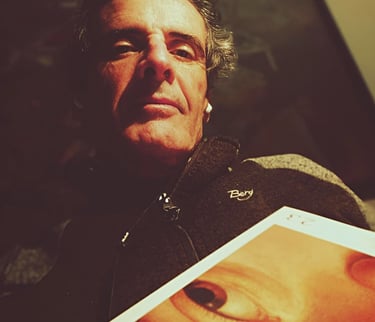
I do not intend to explain my paintings, this is not useful, what is useful is to give a perspective of how it got there so that the result can be better understood, so that the explanation helps to understand the work and so it can be enjoyed without reservations. The most important thing we can do to dignify someone's work is to put ourselves in front of that person's painting and stay there for some time with eyes wide open, without prejudices or complexes, respecting the individual vision, the artist's portrait, seeing what really is unique. I do not intend to emphasize this difference except on the context side, as each one contributes to the process of adding small nothings to the great human heritage.

The landscape is the image of the world, that's how I see it. It is not just nature, a valley or a mountain, a forest or a river, it is more than that because we are there to observe with our eyes full of experience and history, we cannot be oblivious to this, it is not possible to think that the Creation happens with the precision of finely tuned machinery, it happens because it has a past and a future, both are constantly in motion and both follow indeterminate rules from our point of view. About reason, it can be said that it is useful, that it is a good tool to filter doubts, to make choices, but it can also be said that it throws dust in the eyes, that it deceives, that it does not know how to deal with paradox and absurdity, because convinces us that there are rules when what exists is a moving energy that invents everything at every moment, if there is a rule it is that the rules change and no one knows how this happens in the time scale, we are waiting for it not to happen in our time , in the time of our children and grandchildren, this is the only thing we have to learn to live with, the constant change that joins the determinism of our brief condition with chance and universal chaos towards which everything is heading.

Our hands are fully immersed in the uninterrupted chain of time and so we are inevitably dragged along. The hands and the senses give us the sensation of diving into reality and it is believed that it is a sequential journey where some things come after others but if someone could guarantee us that such a thing does not exist and that after all everything happens outside of time, we would have to rethink many concepts. Perhaps pretending is a good beginning to invent new things and who knows, the way to discover the unthinkable. After all, what we have is palpable reality, this is what we work with, with the film of the many experiences that happen to us, what follows is the elaboration of a complex portrait that includes what we feel and what we know. It's not just about a moment, it's about many moments and that's why we can consider that representing a landscape is like creating a matrix of what happens over time under our noses. A landscape without the eyes of the observer is an unknown, probably quite different from the conventional idea because it escapes the decoding of the senses. In reality, we do not know what is there during our absence, but we know that it does not have the same meaning, it exists as complex matter organized according to certain rules, infinitely small particles of energy that move in rapid movements and that give the illusion of solid state, which makes sense only because our brain decides what to do, interprets and classifies and so mountains and valleys arise, dark and light, the beautiful and the ugly make their to our eyes. My concept of landscape was built not by observing what is static in nature but from the latent energy that transforms it. There are the seasons to be seen, the temporal eras that determine great extinctions we can read about, the cyclical cataclysms and the serenity that follows, these are the proofs that the essential lives on change and to take advantage of this change it is necessary to register not the permanence and the uniqueness but difference and multiplicity. The boldness of asserting that every little piece of the world is connected to everything else is a delusion of sensibility, it is like entering the game of arbitrariness and throwing the dice of luck, and as we largely depend on luck, it is natural to take risks and assume that we have something to gain from it. That is why it is important to consider contradiction as a driving force, it is the magma of evolution, the essential spice in the great bowl of phenomena that define reality, the sum of opposites that causes movement, the rational and the irrational as two sides of the same coin.

We live focused on what remains and is constant, we like that because when we go deep into the change that time causes, the lines of force of everything around us are relativized, especially space and time and that makes us in fear, we tangibly lose security, but in doing so we claim the right to go beyond appearances, this is what art must do, to delve into improbable states rather than into cartesian thought. It is said that it is necessary to go beyond that because the margin of uncertainty between before and after is a major challenge we must face. It is the discovery of difference that makes the subject fascinating. It is from change that the link between man and nature is born. We may not know exactly what this implies, but if we feel that everything is connected, it must be important and we must understand that the scope of our gesture is not gratuitous, there are responsibilities. If the objective is to create something that remains valid for more than a moment, we must dedicate ourselves to that scope, let's call it understanding or intelligence.

Travel is by nature what feeds the source, the most valuable resource in the process of gathering information that is later used to create. What is the purpose anyway? Is there a clear destination we want to reach? The answer is no. What exists is a direction and this direction lives from a process of trial and error, of a sequential sum that comes to us through regular work, also through "Eureka" moments, but much more through the insistence of doing and redoing, there is no another way to get there. Knowing everything is as useful as knowing nothing, all the trips together are too much, a rude cacophony and that's why parts of those trips are selected and some things are remembered and and others forgotten, the multiplicity is organized in our head on judicious shelves of a mental library, the data that is stored in silence, when we are resting, reading a book or talking to someone, then, at the right moment, the volcano explodes and a new land is created. Can we say that it happens on our merit? For being in the right place at the right time? It's luck? Whatever it is, it works, so it's not a mistake to go with the flow.

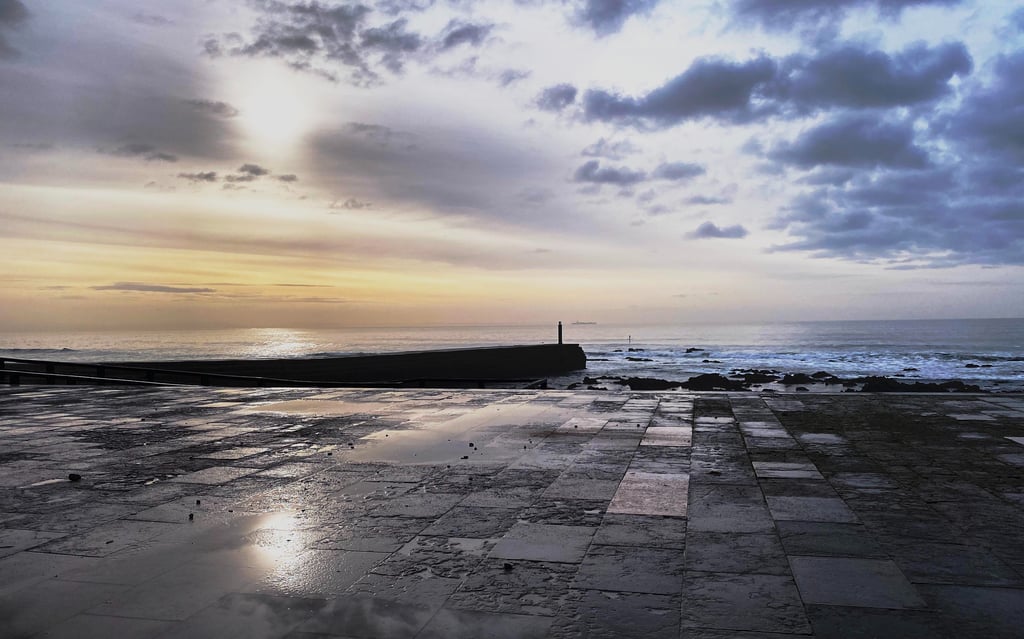
Apparently, the result of this method would be dispersion, but if there was a clear and easy process of joining families, it would be possible to obtain an aesthetically interesting result. It woul be possible to reach an intelligible content translated by the common expression of these families, through their plastic reality in a way that the identity of the image allowed to create bonds with the observer. The arranging of ideas plays a fundamental role in the familiarity between creation and the observer, the landscapes represented on canvas or on paper are models of a reality with its own identity that becomes more readable when the work is presented in series, it becomes easier to contextualize. The sea that is represented is the sea experienced at a certain time in our life, and we can focus on that while working on something more abstract, we can shorten the path but without losing ground so the referential of collective codes is used to understand it is a landscape with personal meaning, more concrete or more abstract, more general or specific, elaborated with the ideosyncrasies of individual experience. My landscape is not the landscape of others and the difference has to do with the way I position myself, how I read through the pages of each lived experience, how I dive into atavistic heritages. Everything has value as long as it represents a point of view and a sensibility that can be understood by others, because communication is an important link when it comes to connecting the present with the past and the future, a necessary step to go beyond the ephemeral. Done in this way, someone who pointed the finger at a work would know what they were seeing because it would evoke the same kind of experiences, yet with all the freedom to add the specifics and idiosyncrasies of each one, being possible identify an idea but not a place or a time when it happened.